Sunday, August 28, 2016

An early fall

Well guys, we made it to the last Sunday of August. August is always a difficult month for me because it's not September. Once the July holidays are over, all I can think about is fall. Some years are worse than others, and this year was worse.

But it's practically fall right now. The meteorological season starts on Thursday (September 1), and astronomical fall starts in a few weeks. But yesterday I went on my first trail run since my twisted ankle--and look at what I saw:


(I also ran into a swarm of dragonflies, which is really more Augusty than autumny.
)

And if those aren't enough to convince you, look at what we made yesterday:


One of my favorite days is the day we make grape juice from the grapes growing in our backyard. I start putting out Halloween things in mid-September, and we usually have our Halloween stuff up when we make grape juice. Sometimes we make it close to my birthday at the end of the month. I thought last year was early when we made it in early September. But I think this is the first year we ever made it in August. Sipping on steaming grape juice straight from the juicer just brings happy memories of autumn.

So. Grape juice = autumn. Ergo, it is autumn. Boom.

(But I'm still going to enjoy popsicles for a few more days.)

I thought I'd try something new with our green grapes, so I made this grape tart.
It gets a 9/10 for cuteness. But it only gets a 4/10 for taste and texture, because it was basically eating cooked grapes, and these grapes aren't the best anyway. At least the crust was good.

At this time of year, the only baked goods I can have are items made from fruit from our own yard. We have apricots, plums, and grapes, and my sister has a cherry tree. So this summer, I have made the following items with our free fruit: cherry crisp, cherry-chocolate sorbet that didn't set up, cherry strudel, cherry salsa, apricot crisp, apricot meringue pie, roasted apricot and onion salsa, apricot jam (actually my mom made that), apricot omelet, apricot pudding, plum-rosemary upside-down cake, roasted plum and pudding tart, plum crisp, plum cobbler, grape tart, and grape juice (my mom "made" that one too). I might be missing some. That cookbook I got for my birthday last year, How to Cook Everything Vegetarian by Mark Bittman, has proved very helpful. I don't know whether I'll squeeze anything else out of the remaining produce, other than some more juice.

This week I fell "victim" to the power of advertising. I saw a commercial and I just had to have the t-shirt the guy was wearing, so I ordered it. But the commercial wasn't even about t-shirts. It was about water conservation. Which is even more important, as my groundwater class three years ago taught me.

And so, with the power of advertising, I am going to praise the movie Kubo and the Two Strings, which I saw this week. I think it was only the second movie I saw in a theater this year. It's made by Laika--I saw Boxtrolls and half of Coraline; never saw Paranorman. But I'm going to venture that this one was their best. So. Good. And it's also the cleanest. It is somewhat scary, but there are no bad words or gross things in it. Beautiful.

I started by talking about leaves and ended up talking about movies. Oh well.

Sunday, August 21, 2016

Gerontology

At my work, there are a lot of senior missionaries. Most of them are just what you'd expect them to be. Some of them seem like professionals even though they are just volunteers. And some of them are, well, quirky. I'm not saying anything about whether they are good or bad, smart or not, or anything. I know they are all wonderful people and probably quite intelligent.But they have their oddities.

There is one in the cubicle across from mine. I don't really talk with him, because he doesn't seem to be into conversation, and the few times I've talked with him, I've had a hard time understanding him. He kind of has a Jimmy Stewart manner of speaking, kind of mumbling and stammering.

When I started there, I thought, "It's cool that he still volunteers when he's so old." He appears to be in his 90s. I heard another missionary say, "He looks like he's 114." But then I heard this old missionary tell someone he was only in his early to mid 70s. I was shocked! He's a decade younger than my grandparents but looks a decade older. He has typical old features--wrinkles, baldness, gray hair, hearing aids--but they seem too advanced for someone his age. In addition to those, he has scoliosis, so he is hunched over badly, and he has that foggy look in his eyes you'd expect from blind people, but he's not blind. He's also, well, very flatulent. Every time he gets up or walks down the hall. I'm embarrassed for him.

Since we're just an open area with cubicles, we hear everything everyone else is saying. And he has a few set expressions he says over and over:

  • "You dumb thing! Arr!" He mumbles this one the most, channeling his inner pirate when he gets frustrated with his computer, which is very often. I'm not sure what he gets so frustrated with. Maybe his computer is as slow as my work computer.
  • "That's wonderful." Wonderful is apparently his favorite adjective.
  • "My goodness! You're here!" Usually followed by "that's wonderful." He usually says this when someone stops by his desk, but once he said it to me when we met at the stairwell. I found it an odd response.
  • "You came to see me!" He says this when he doesn't say "My goodness you're here." 
  • "That's nice of you." He says this as often as most people say thank you.
  • "Good morning." He says this when he answers his work phone (which has a very loud ringer), even if it's 5 p.m. I think he's usually talking to his wife, but I don't know if that's always the case. I was shocked the one time I heard him say "Good afternoon," because I didn't think it was part of his vocabulary.
His wife also volunteers there some days, and assuming she's close in age to him, they both must be drinking from the Fountain of Aging, because she is very wrinkly and a little hunched over. But she doesn't have gray hair, because she dyes it orange. One day she was wearing a SpongeBob Christmas t-shirt with a sweater and skirt--and it wasn't even Christmas!

Now, this week, there was a presentation at work about social media use in Africa. His wife came to his desk and said, "They're having a presentation on black people." I found that an exceedingly strange thing to say. I mean, there were some African kids on the announcements, but you think they would just have a presentation on black people? And then she said, "Do you want to go to the Negro thing?" If "Negro" is even what she said.

A minute later, he said to his wife, "You should have two necks." An unusual thing to say, but I figured he was going to say something about necklaces. I wasn't prepared for his follow-up:
"All the better for necking."
Either he forgot that we can hear everything, or he doesn't care.

Old people have been on my mind this week. Especially when they are awkward on the internet.

Sunday, August 14, 2016

August awkwardness

I'm in for some changes this week. A year ago, I quit working for my boss at the Church History Department and began working on a different project. A year later, my time on that project has come to an end.

In June, I had a fortuitous adventure. I went up to Mueller Park for a run, and my old boss just happened to be at the trailhead at the same time I was. I talked with him for the first few switchbacks before I ran off. The following week, he called me and offered me to work for him again, and I accepted--so this week I begin working on his projects again. While I've loved my projects of the past year, especially the opportunity to work with more people, I'm excited to get back to his projects. He credits that happenstance meeting on the trail as a catalyst that made him consider me again, and the timing was right--although I do wonder if he would have thought of me even if we hadn't met that day.

In frivolous fruit news, the first grapes of the season are getting ripe, and our plums are the best I can remember. And to think I didn't used to like August, the month of monsoonal thunderstorms, fresh fruit, and popsicles and shave ice!

Since 2009, I have been a big supporter of local singer-songwriter Cherie Call. I thought I had all of her songs (not counting hymn covers), but recently I learned about three I don't have, so as a super fan, I still have two more I need to get. Unfortunately, they're only available on girly, churchy compilation CDs that I don't particularly care to have. But I guess I have to get them, because the only other way is iTunes, and I've heard horror stories about iTunes.

Anyway, she recently teamed up with another local singer/songwriter, Lyndy Butler, to produce a "children's" album. It's not up to par with her previous work. But yesterday she had an album release concert at This Is the Place State Park, so to be a supportive fan, I took my family to see it (my mom is also a fan, thanks to me). The park was technically closed, but we walked around and saw a one-antlered deer.
Anyway, the concert was, well, awkward. It was very low attendance. I've seen Cherie Call, I don't know, about a dozen times, and this was the worst attendance I'd ever seen (except for that one time at a radio station on a weekday morning), even though there were two of them performing. I had the feeling that we were some of the only, if not the only, people there who didn't know the performers personally. So the low attendance was awkward, and depressing. But the show didn't actually get started for twenty minutes, because they were off feeding Jimmy John's and cookies to their families. And then they decided to start the night with another singer. I'm not going to humiliate him by calling him by name (also, I don't remember it), but he was not very good. His first song was all falsetto--and not a deliberate Adam Levine, Jason Derulo, or even Frankie Valli falsetto, but a genuine "I wrote a song that's too high for me" voice. It was painful. He also sang some educational songs (he's a teacher) that were the kinds of songs you'd teach a class to help them remember, not perform in a concert. But his stage presence was just awkward. Imagine if I were on stage at a concert. That's how awkward it was. I kept hoping for his turn to be over, but he sang five or six songs.

The rest of the concert was good, but I just felt bad for them for how low the attendance it was. It was certainly uncomfortable. But I felt better about being there since there were so few people, so I could show support. It was a great venue and a beautiful evening. Just not a great circumstance.

Sunday, August 7, 2016

Fruit Games

It's August now. You know what that means? Time to tell you all about how I used to hate August but I don't anymore! I don't really like August's heat or lack of holidays, or that all my insecurities were taunting me this week--but I do love August's thunderstorms and laid back atmosphere. Sure beats January.

Once upon a time I was a missionary, and my favorite form of humor was scriptures taken out of context. This one sums up this time of year quite well:
Thus hath the Lord God shewed unto me: and behold a basket of summer fruit.
In mid to late July, and lasting into August, we always have apricots. I think this year we have an unusually high number. They're not as sweet this year, but they're still good to put in other things. So far we have had apricot crisp, apricot omelets, apricot jam, apricot salsa, and apricot meringue pie.
(At this time of year, the only desserty things I can have are popsicles and their cousins, and things made with our own fruit.) Unfortunately, I have to park under the apricot tree, resulting in a very messy car.

In August, our plums turn ripe. Of all our free-growing plants, the plums are best for simply eating. I like grapes more for juice, but the plums are the best by themselves. This year's crop seems to be unusually good (unlike the apricots). I don't know whether I'll make anything with them simply because they're so wonderful plain.

Now, we are not good farmers, gardeners, or hipsters, so we aren't good at growing things. We have a little vegetable garden in the back that's not doing very well (thanks in part to those pesky deer). So I'm grateful that these trees just take care of themselves and we don't have to do anything, except maybe water the lawn.

The Olympics started this week. It seems ironic to me that the summer Olympics take place in a place where it's winter. It makes me feel bad for the southern hemisphere. I mean, why do the summer Olympics have to take place in July or August? Why can't they take place in January in South America, especially since they only happen every four years (two if you count Winter)?

I halfheartedly watch the Olympics, mostly because I feel it's my patriotic duty to do so. I don't watch sports any other time. Even the worst Olympian could beat me in any event, winter or summer.

It got me thinking about being American. In many ways I do feel a bit xenophobic. I mean, if China does well at something, I think, "Yeah, but they're communists." If Mexico does something well, I think, "Yeah, but they have a massive drug problem." Sometimes I'm a terrible human being. But I really do think the United States of America is the best country around.

But I don't feel like I can say I'm proud to be American. I can be proud of miles I run or books I author, but being American for me isn't an accomplishment. I never chose to be American, at least not that I can recall. The only people who chose to be Americans are immigrants.

And why should I be proud when Americans win Olympic events? I didn't do anything to make them win. No effort on my part. None. If I were an American's coach or friend, then I might feel proud, but not as an idle spectator. While the athletes were off training their guts out, I was eating cookies and wasting time on the internet. (I have found more satisfaction in life the less time I've spent on the internet.)

There's also the issue that we make it easy to be a good athlete. (Well, not easy, but more likely.) Sure, we have the best swimmer in the world. But we are the land of opportunity. I guess it would be much more impressive if someone from some poverty-stricken third-world country won. While I was getting my tires changed yesterday, I watched the beach volleyball game between the U.S. and Qatar. America was much better than Qatar. And those playing from Qatar weren't even native Qataris. One was from Brazil and one was from Africa (Google's letting me down on the country). If Qatar were actually good, it would be astounding. But America being better? Meh.

But I love America. Even if I did nothing about it.

*The title from my post is an allusion to Google's Doodle Fruit Games, which I thought was appropriate because this blog was about fruit and the Olympics.

Sunday, July 31, 2016

Ankle

Well, guys, it finally happened. I finally injured myself on a trail run.

Yesterday I was running up to Elephant Rock in Mueller Park. NBD, I've run there several times this year (it's the shadiest trail around). But I was especially exhausted yesterday for some reason, maybe because I had run the night before. I thought about stopping, but when some downhill bikers stopped to let me pass them going up, I felt like I had to keep going so that their kindness wouldn't be in vain. I pushed through the difficulty and made it to the rock. However, soon after turning around I misstepped and twisted my ankle. I had to limp two and a half miles down the trail back to my car.

Sometimes I wish I could be laid up so that I will have an excuse to do whatever sedentary thing I want. I certainly wish I hadn't sprained my ankle, but as far as being laid up goes, this is probably the best way to go. I can still hobble around, but it's better when I'm off it. There was a Green Acres marathon yesterday, which was fortunate. (One of the episodes was "The Beverly Hillbillies," in which Eb gets a sprained ankle and Oliver gets a broken toe. It was fitting.)

Now, if there are any haters out there who are going to tell me that this happened because trail running is dangerous--don't. I think this ankle is prone to sprains now, because this is the third time this has happened to that ankle. The first time was when I was practicing biking right before my mission and sprained it pretty badly. The second time was about two years ago, when I was running and accidentally stepped of the sidewalk. This time was just another unfortunate thing. (It might also be the same ankle I sprained on the stairs in fifth grade, but I can't remember for sure. I would say that that doesn't count because it was so long ago--but then I realized that the time between fifth grade and my mission is less time than between the beginning of my mission and now!)

The twisting this time around seems comparable to the one two years ago, and it was a quick recovery then, so I hope that will be the case this time. My goal for the autumn is to run up North Canyon to Rudy's Flat, then down to Elephant Rock and down Mueller Park. (Everything is better in autumn, especially trail running.) In preparation for this, last week (July 23) I ran a mile past Elephant Rock. I went a total of 8.77 miles that day, the longest I'd ever run. But even though it was my personal best, I got smoked by two other runners, and I think they were going farther than I was. Nevertheless, I am satisfied that I was able to run so long, including four straight miles uphill.

Monday was a day off work for Pioneer Day. This was my second year formally celebrating Pioneer Day, but it still only feels like a half holiday, even though it has all the trappings of a full-blown one. But I don't celebrate holidays when they're over, so regardless, July 25 wasn't really a holiday anyway. On Memorial Day, I wanted to go up Holbrook Canyon, but I decided I would wait until the runoff let up, so on Monday this week I went back.

It is a pleasant area.
 However, it is full of stream crossings, with numerous makeshift bridges. Despite all my best efforts, I did get my feet wet, since logs break and rocks are slippery. And even when you're not crossing the main creek, there are tons of small tributaries that run directly on the trail. But having wet feet wasn't as bad as I expected.
 There were many thimbleberry plants, so I had to try one. (Don't worry, my wildflower book says they're edible.) It was like a raspberry, but when I ate it I remembered that our fruits you find in a grocery store have been bred for taste. The thimbleberry wasn't super sweet. But it was nice to connect back thousands of years to some primal hunter-gatherer ancestors, picking wild berries for food.
 The trail had lots of ups and downs, so I gained 1600 feet, but it didn't really feel like it.
 I had read that a lot of the trail was overgrown, but I didn't realize how much. The trail is in the picture below, believe it or not.
 Wildflowers are better in the spring, but there were some nice Richardson's geraniums.
 There were lots and lots of burrs that stuck to me. They matched my green shirt.
 It was refreshing to see some prominent rock outcrops, instead of just random boulders or things sticking out of the trail. This one appeared to be quartzite, which is probably my favorite common rock. This was a nice diversion from the conglomerate I usually see closer to my house.

 This looked like slate.

It was nice for a change, and while it was a pretty place, I wouldn't recommend it for running. I spent probably half the time walking, since there were so many stream crossings, confusing trail forks, and bushwhacking sections. My fastest mile on this trail was slower than my slowest mile on any other. I hear that people bike this trail, and while I'm no biker, I think it would be a terrible place to bike.

When I was on vacation this month, I managed to gain three pounds. That's what happens when you're in a car all day next to the snack box. In addition to that, I realized that outside of non-seasonal treats, I eat pretty much whatever I want, and those eating habits aren't very sustainable. I thought it would be helpful to keep track of what I eat during the day--and then I remembered that my Fitbit app counts calories, so I thought I would give it a go.

It's not like I'm super concerned about my weight, but it has been a helpful tool. It tells me how much I've eaten and how much I can still eat. I know it's not super accurate, but it's still helpful. It makes me make wiser choices, like, "I've already eaten dinner, and I'm not hungry, so I don't need any more," and "It's not worth inputting the calories for that snack." In two weeks, I've already lost the pounds I gained on vacation, plus a little extra. When I put on my belt this morning, I had to go down a hole.

Since my permitted calories go up when I run, it gives me more motivation to do so. (Now, I've read that you kind of cap off at calories burned, so the more you exercise, the less accurate it is, but I'm still going to pretend it's accurate--because I won't be eating more than I was before anyway.)

That's the biggest bummer about my ankle. I can't burn as many calories. And then I can't eat as much.

Sunday, July 24, 2016

The Failures of the Pioneers


A talk given in the North Park YSA Ward in Bountiful, Utah, on July 24, 2016.


I am delighted to speak today about the pioneers. I am not a history person—history was always my worst subject in school—but God has placed me in situations and circumstances where I am privileged to learn about the sacrifices and efforts of the pioneers. Some of you in the audience may feel like pioneers are irrelevant to you, because you don’t have a pioneer heritage. Some of you are converts, or your parents or grandparents may be converts. To be more inclusive, while I do have pioneer ancestors, the stories I will be sharing today have nothing to do with them, so I hope we all can find value in the example of the pioneers.

When we talk about pioneers, we have images of wagons and handcarts, and we sing that pioneer children sang as they walked and walked and walked and walked[1]—we focus on the overland journey so much that it makes it seem like when they arrive in the Salt Lake Valley, that’s the end of the story. But really that’s just the beginning of the story. In a historical sense, the Utah pioneers are defined as those who arrived between 1847 and the completion of the transcontinental railroad in 1869. I want to talk about some of the events that occurred in Utah during the pioneer period.
The pioneers had many successes. The very fact that we are here today is proof of that. After Brigham Young and his company arrived in July 1847, many of them left the next month to go back to Iowa. On their journey, these outgoing pioneers met the company of Perrigrine Sessions, and they told him a little about the valley. He arrived in Salt Lake, and soon he went a few miles north and established a farm. This area was called Sessions Settlement initially, but eventually it became Bountiful.[2] He is buried in the cemetery across the street.


However, with all their successes, the pioneers had a lot of failures. I’m going to talk about a few of their failures.

In the early 1850s, John Taylor was on a mission in France, and Brigham Young had asked John  Taylor to look for new ideas that would be useful in Utah. He discovered that in France, they extracted sugar from sugar beets, and he thought that would be a valuable idea, because sugar was scarce in the desert. So he bought a bunch of French sugar beet seeds and some equipment for extracting the sugar. It was a major hassle getting the equipment across the plains. Once they got here, actually extracting the sugar didn’t work. One of the batches of molasses even the hogs wouldn’t eat. Decades later there was a successful sugar industry, but in the 1850s it failed for a number of reasons.[3]

Another kind of failure they had was in missionary work. There were many converts who came from Denmark and Scotland, like my ancestor Alexander Melville, but they sent missionaries to other places in the world, and these missions weren’t very successful. For example, in 1852 Hosea Stout, James Lewis, Walter Thompson,[4] and Chapman Duncan were called to China. James Lewis and Chapman Duncan were both in Iron County, and word arrived that, “Hey, BTW, you’re going on a mission to China. Time to say goodbye and pack up.”[5] James Lewis described that as the great trial in his life. When they arrived in Hong Kong, they couldn’t do anything. They didn’t speak Chinese, and no one who spoke English would listen to them. They couldn’t go to the mainland of China, just like today, but for different reasons. After two months they prematurely left their mission because it was fruitless and returned to America.[6]

Growing up, I heard that Las Vegas had been founded by Mormons. That’s only somewhat true. In the 1850s, Mormons did establish a settlement at Las Vegas, in part so that there would be a waystation for travelers going to California. People were called on missions to go there. Some were assigned to mine, and some were assigned to preach to the Native Americans in the area. Due to several problems, including clashes between the missionaries, the settlement failed and the missionaries left, and their Las Vegas settlement was completely abandoned. The Las Vegas of today has nothing to do with the Las Vegas of these early Mormons.[7]

Now, what strikes me about the pioneers, in all these efforts, is that they were not afraid to fail. Often I doubt myself and think I won’t succeed, so I won’t bother. When I do that, I don’t fail, but I don’t succeed either. The pioneers didn’t seem to be scared of failure. They accomplished many things that they didn’t know would work, because they had faith in what they were doing.

Think further about the failures. For me, I don’t think, “Oh, what dumb pioneers. What were you thinking, sending people to China? What were you thinking, settling a town in Las Vegas?” No, I am impressed by their determination, their efforts, and their ambition. Sugarhouse today is still named for the unsuccessful sugar factory, and the manhole covers in the neighborhood have sugar beets on them. 
We don’t call the area Failureville. I need to remember that if I fail in my efforts, it does not make me a failure, nor does it disappoint the Lord. Failure is a part of life and a part of learning and growing.

Now, this does not mean we can be irresponsible and reckless. We need to realize severe consequences come from unwise decisions. One historical moment that could have used a little discretion was the Willie and Martin Handcart Companies. I’m a little hesitant to talk about them, because I feel like we hear their stories over and over—you may be watching 17 Miracles this weekend, or doing your home teaching using President Monson’s story about Shane’s ancestor.[8] We often place misleading emphasis on handcarts, when only 4 or 5 percent of all the pioneers actually used them. However, I think we usually tell the wrong side of the story—the suffering and deaths caused by a series of poor decisions. Frankly, I don’t find that terribly inspiring. I am much more inspired by the reaction of the Saints here in Utah when they learned of the plight of the companies.

For years, Brigham Young had wanted to use handcarts, because many Saints were coming via aid from the Perpetual Emigrating Fund, and handcarts would be cheaper and faster without having to worry about all the oxen and wagons. There would still be a few wagons traveling with the company, but they were mostly handcarts. In 1856, they finally experimented with handcarts, and in the fall of that year, three handcart companies successfully arrived. Brigham Young was delighted, as their experiment was a success. Then Apostle Franklin D. Richards arrived and informed him that there were still two handcart companies way back on the trail, which was not a good thing. This was early October, right before general conference. Many missionaries had just returned, and they were to be speaking. When Brigham Young opened the conference, he explained that the theme of the conference was “to get them here.”

He started with, “I wish the most strict attention of the entire congregation.” He then admonished people to be quiet and mothers to take their noisy children out. This is something we can relate to when we visit family wards. Speaking of parents who don’t take noisy children out, he said, “I cannot say much for the education, based on good feeling, that such persons have. Were I to describe it in a plain way, I should say that they are people of no breeding, that they were never bred but came up; that is about as good a character as I can afford to give to any mother that will keep a squalling child in a meeting.” That may sound harsh, but they didn’t have microphones back then, and they were meeting in the bowery, which didn’t have good acoustics, and this was general conference. But he had very important things to say. He said, “I make these remarks because I wish the brethren who will speak to you to-day, the Elders who have lately returned, to be heard. . . . Many of our brethren and sisters are on the plains with hand-carts, and probably many are now 700 miles from this place, and they must be brought here, we must send assistance to them. . . . That is my religion; that is the dictation of the Holy Ghost that I possess, it is to save the people.”[9]

Sister Linda K. Burton, Relief Society General President, talked a little bit about this incident in her own general conference talk in the context of helping refugees.[10] Like her, I admire the powerful words of Brigham Young:

I will tell you all that your faith, religion, and profession of religion, will never save one soul of you in the celestial kingdom of our God, unless you carry out just such principles as I am now teaching you. Go and bring in those people now on the plains, and attend strictly to those things which we call temporal, or temporal duties, otherwise your faith will be in vain; the preaching you have heard will be in vain to you, and you will sink to hell, unless you attend to the things we tell you.[11]

The things he told them were a call to action. He continued, “I want the sisters to have the privilege of fetching in blankets, skirts, stockings, shoes, &c., for the men, women and children that are in those hand-cart companies.” And indeed, right there in general conference, women took off their petticoats and stockings to donate. I only wish I could be so generous.

Many of us here have been on missions, and I find that the words Brigham Young told the RMs of 1856 still apply to today. Only men were sent on missions in those days, but his words apply to sisters as well:

I request the elders of Israel who have been on missions abroad, also those that are now on missions, to keep the Spirit of their missions, if they have it; do not lay off your gospel armor. Laboring abroad is but a small portion of the good an elder can do.…Our elders have got to take a stand to never follow the crowd, but to walk in the footsteps of their Redeemer. [12]

On my mission, I truly remember loving people that I otherwise would be unlikely to know, much less love. I grew to love addicts, recovering criminals, and all sorts of people who are very different from me. I suspect that was the same with others. We need to find a way to maintain that love for others, both those who are different and those who are the same.

At this conference, Brigham Young said they needed people to go rescue the companies the very next day. If no one would volunteer, they would end the meeting immediately so that the First Presidency could go help. So they took a vote:

“It is moved and seconded that Brigham Young, Heber C. Kimball and Jedediah M. Grant go back to help the P. E. Fund Emigrants. Unanimously negatived.” Everyone in the audience recognized that it was their own duty to help the Saints, not just the First Presidency's.

“Pres. Kimball called on the blacksmiths in the congregation to retire; as they were wanted to shoe the horses and repair the wagons of those about to start to assist the brethren on the plains.” [13]

I am impressed with the immediacy of this situation. Saving people was more important than their meetings.

I can remember this happening in this very ward nearly five years ago. In December 2011, there was a huge windstorm that came through the area. Trees were toppled all over the place. So the first Sunday in December, they announced that we would not be having Sunday School or priesthood and Relief Society. We would be going out to help clear fallen trees. Now, this was not nearly the same magnitude or seriousness as hundreds of people out in dire conditions on the plains, but it was a modern-day example of putting the gospel into action.

After this incident, Brigham Young chided Franklin D. Richards. Elder Richards had told the Martin Company of the dangers they would face leaving so late, but he let them vote on it, and they all decided to go. Brigham Young told him he should not have let them go, even when they voted on it. Many of the pioneers believed that since they were doing the righteous thing by gathering to Zion, God would save them. But Brigham Young said that faith without works is dead.[14] You can’t make unwise decisions and expect God to save you in them. A little discretion is necessary.[15]

Even though he recognized they had made poor decisions, though, he still insisted that they be helped. It didn’t matter that it was their own fault. It reminds me of King Benjamin’s address in Mosiah 4:
And also, ye yourselves will succor those that stand in need of your succor; ye will administer of your substance unto him that standeth in need; and ye will not suffer that the beggar putteth up his petition to you in vain, and turn him out to perish.
  Perhaps thou shalt say: The man has brought upon himself his misery; therefore I will stay my hand, and will not give unto him of my food, nor impart unto him of my substance that he may not suffer, for his punishments are just—
 But I say unto you, O man, whosoever doeth this the same hath great cause to repent; and except he repenteth of that which he hath done he perisheth forever, and hath no interest in the kingdom of God.[16]
We have a responsibility to follow the Savior and help each other. Even when their struggles are their own fault, even when they’re hard to love, even when we may disagree with their decisions. That is true religion. That is what we can learn from our pioneer heritage.


[1] “Pioneer Children Sang as They Walked,” Children’s Songbook, p. 214.
[3] See Mary Jane Woodger, “Bitter Sweet: John Taylor’s Introduction of the Sugar Beet Industry in Deseret,” Utah Historical Quarterly 69, no. 3 (Summer 2001): 247–63.
[4] Due to sickness, Walter Thompson didn’t make it past California.
[5] Not an actual quote.
[6] See Reid L. Neilson, ed., “Early Mormon Missionary Work in Hong Kong: The Letters of James Lewis to Apostle and Church Historian George A. Smith, 1853–1855,” Mormon Historical Studies, forthcoming.
[7] See Fred E. Woods, A Gamble in the Desert: The Mormon Mission in Las Vegas (1855–1857) (Salt Lake City: Mormon Historic Sites Foundation, 2005).
[8] Thomas S. Monson, “True to the Faith of Our Forefathers,” Ensign 46, no. 7 (July 2016): 4.
[9] Brigham Young, “Remarks,” Deseret News, Oct. 15, 1856, 252.
[10] Linda K. Burton, “I Was a Stranger,” Ensign 46, no. 5 (May 2016): 13–15.
[11] Young, “Remarks,” 252.
[12] Brigham Young, “Remarks,” Deseret News, Oct. 15, 1856, 256.
[13] “Minutes of the Semi-Annual Conference,” Deseret News, Oct. 15, 1856, 256.
[14] James 2:17.
[15] See Howard A. Christy, “Weather, Disaster, and Responsibility: An Essay on the Willie and Martin Handcart Story,” BYU Studies 37, no. 1 (1997): 6–74.
[16] Mosiah 4:16–18.

Sunday, July 17, 2016

Land of the Giants

Last weekend I flew into California for a little vacation/family time, and this was the week that interesting things actually happened.

On Monday, we (my parents and brother and nephews) drove out to Kings Canyon and Sequoia National Parks. California has eight national parks, but it's more like seven, because Kings Canyon and Sequoia are practically the same. We visited the same parks in 2013, but it's fun to return.

We saw the General Sherman, the largest tree in the world, which is neither the tallest nor the widest but the most voluminous. I can't remember whether this one is it, however, as there were lots of giant trees.

These kids love Nutella, and Franklin grew a goatee by smashing his face into his bread. He cracks me up.

On Tuesday, we went to places we hadn't been before. Kings Canyon has two disconnected areas in its boundaries, so we went to the larger portion and saw a few interesting places there. However, the larger portion is mostly backcountry, and we're not backcountry folks, so we only saw a few minor things, such as this waterfall. The granite of the Sierra Nevada is much older than the granite I'm used to seeing in the Wasatch Front.

We also spent time in Sequoia National Forest (as opposed to the national park), which was less restrictive. My nephews really didn't want to go on this little hike, but we got them to go. We passed through recently burned forest.

This area of the forest was heavily logged at the turn of last century, and there are lots and lots of giant sequoia stumps. They literally logged thousands of them. We have differing values in the twenty-first century.

The main focus of the trail, however was the Boole Tree, the sixth-largest in the world, and the only big tree (or one of the only trees) the loggers spared. Since this was a national forest instead of a national park, we were able to go right up to it and appreciate how massive it really was. Here are Preston (11) and Nathaniel (6) for scale. There was graffiti scratched into the tree, because apparently people like to memorialize that they are terrible human beings.


There were a few cracks where you could actually get inside the tree. I asked my dad to take a picture of me in the crack, but apparently he's smartphone camera illiterate.

This trail was a loop, and Preston and Nathaniel were dismayed to learn that we were completing the loop, which made it longer, but for all their complaining they seemed to enjoy running down the trail. (Franklin's not as big into the running.) I kept up with Nathaniel, and he's quite fast, faster than I usually am on a trail.

I don't know if these were sego lilies or one of their relatives, but it was nice to have a Utah feel in the Sierra Nevada. 

My nephews are all quite competitive, so when we got to the bottom Nathaniel was delighted that he won. I think they enjoyed it, even though Preston refused to acknowledge it.

My mom had bought my nephews souvenirs, and the older boys got gigantic pencils with their souvenir money, but Nathaniel had already spent all his. He was quite envious of the pencils, so he "sold" one of his animal flipbooks back to my mom and obsessed about getting a giant pencil. It was all he could talk about, and we never returned to the one gift shop that sold them.

On Wednesday, we packed up but saw a few interesting things before we returned to my brother's residence in the Bay Area. We went to see the Chicago Stump, which was a giant sequoia that was cut down and shipped in pieces for the 1893 World's Fair, but they thought it was a hoax because it was so big. There was a smaller stump nearby that all three nephews climbed.
 However, what Franklin lacks in running, he more than makes up for in climbing. He is amazing at climbing, and he climbed up the whole Chicago Stump, which was probably twenty or thirty feet high. He scared us doing so, but he made it. Preston was too scared to do it, and we told Nathaniel he was too young. (He wasn't happy about that, just like when we told him he was too young to light fireworks on the Fourth of July.)
 In another life, I would like to be an entomologist.

On Wednesday evening we took my nephews to the drive-in to see The Secret Life of Pets, a movie so forgettable I almost forgot to put it here.

We had one more full day with my nephews before ending our month-long visit with them. I will miss Nathaniel saying things were "bloken," Franklin calling me "Grunkle Uncle Mark," and Preston's pseudo-political discussions. (Well, I probably won't miss those.)

On Friday, my parents and I headed up to a national park where I'd never been, Redwoods National Park. (Here I am, 27 years old and taking road trips with my parents, since nobody else ever invites me.) There are actually several Redwood state parks in the area, and I don't entirely know when I was in a national park or a state park, much less which state park. While I love being a native Utahn, sometimes I get California envy, and I certainly felt that here. There were coniferous forests right next to the ocean.
 This picture of the mountain was taken at the beach.

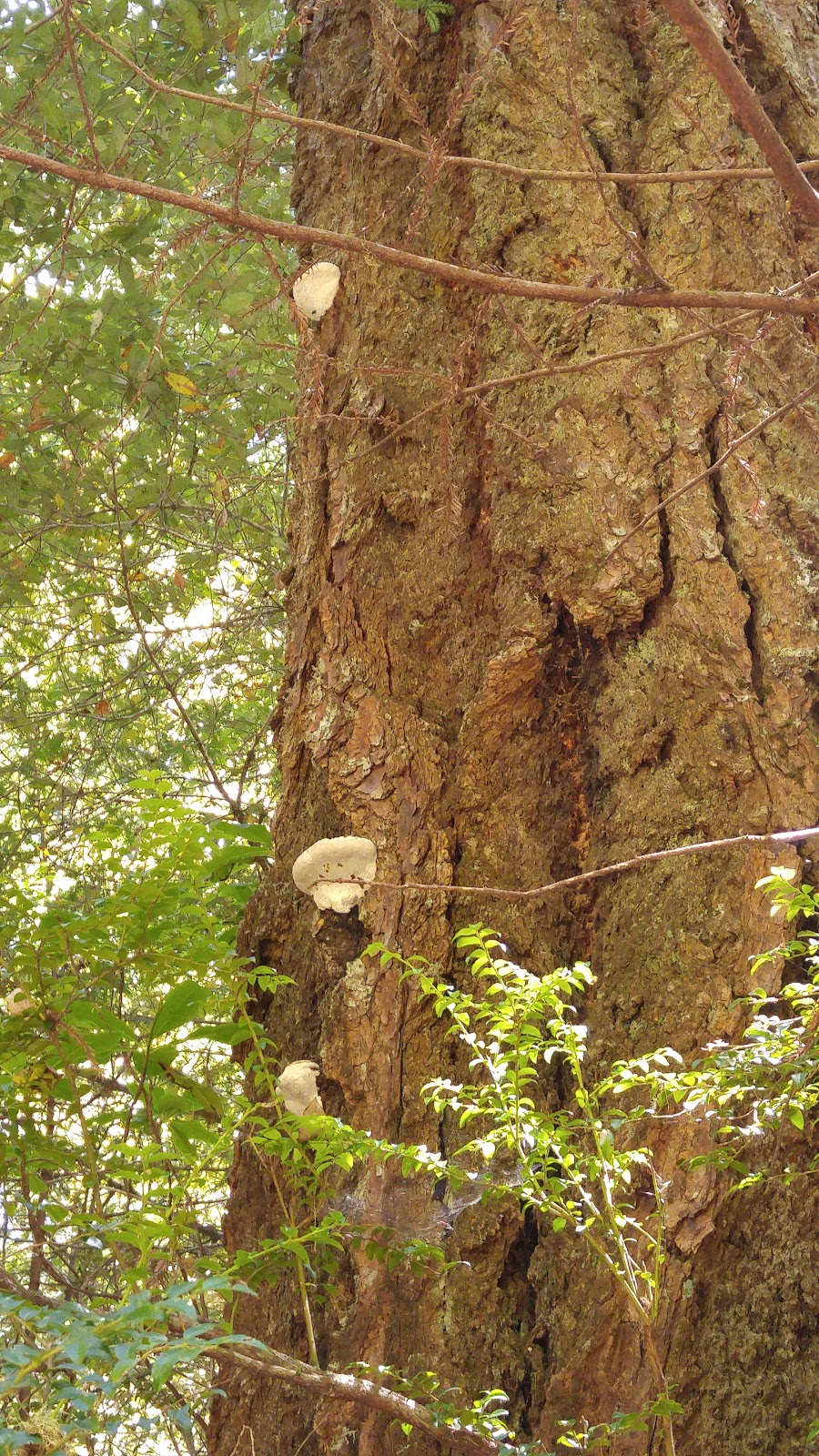
We went to the Ladybird Johnson Grove, and I know that was in the national park. It was amazing. It felt like being in a magical forest. Redwoods are the tallest trees in the world (as opposed to sequoias, which are bigger but not taller), and there were plenty of them in the forest. But there were other enchanting things. Like large tree mushrooms,
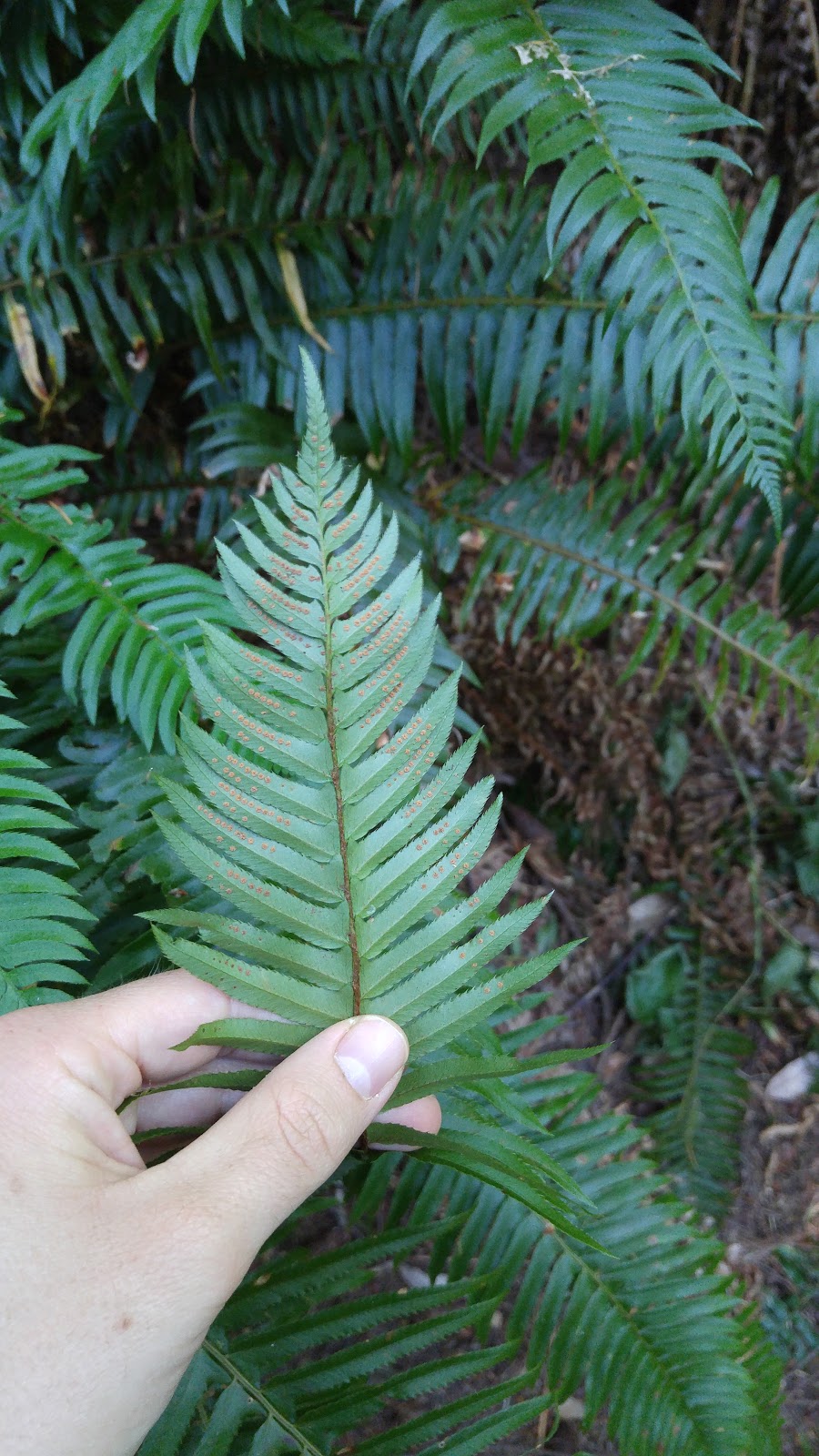
 ferns,
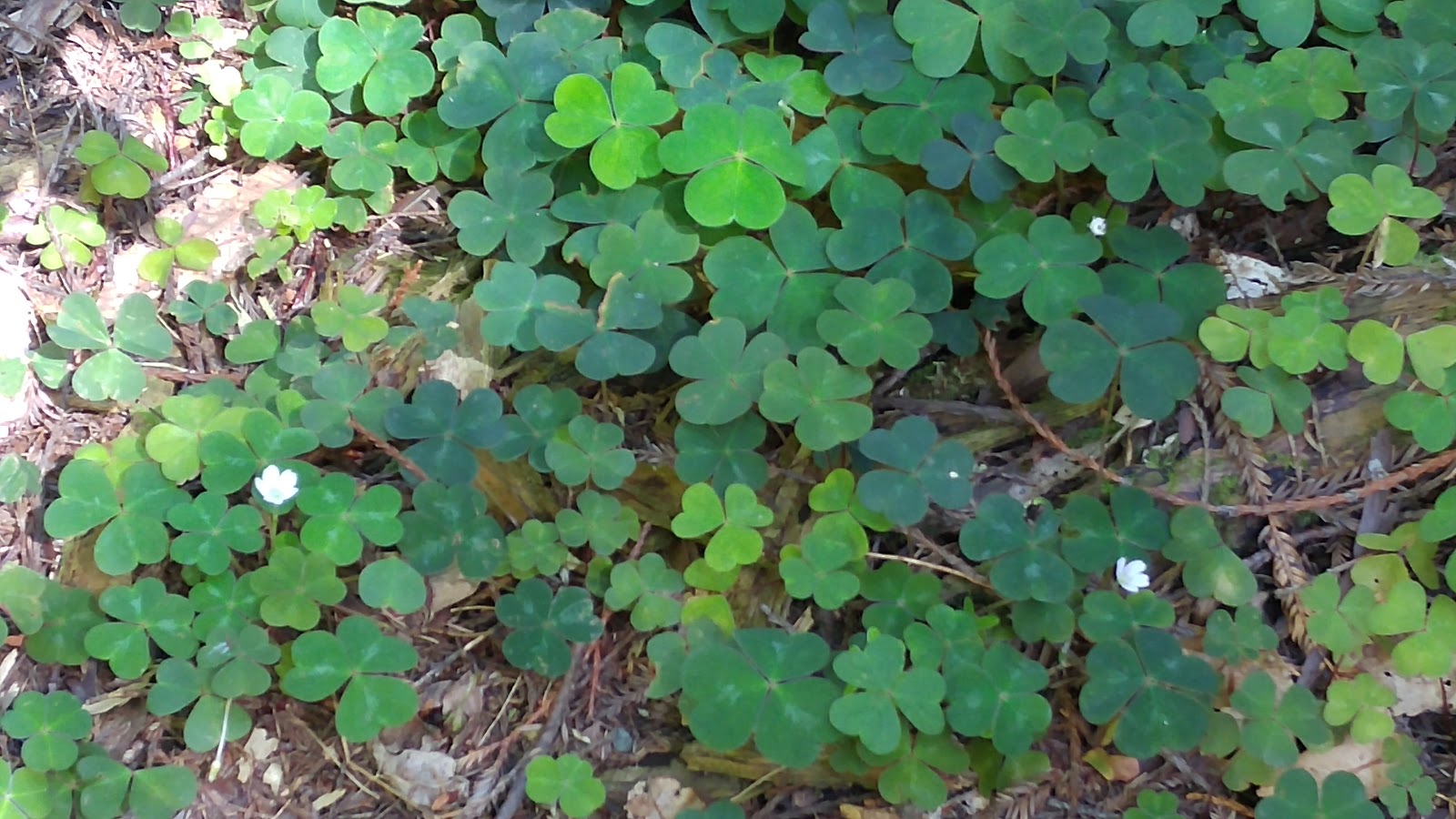
 shamrock-like plants,
 and even entire patches of ferns up in the trees! An ecosystem above the ground kind of blows my mind.
 I also liked looking at the spore-producing parts on the bottom-side of fern leaves.
We had a camping spot in a state park, but we decided we were too tired to camp, so we stayed in a hotel in Crescent City, CA.

The next morning we drove up to Oregon to see another national park I'd never visited, Crater Lake. I'd learned about Crater Lake in my geology classes but this was my first time seeing it for myself. Once upon a time, one of the Cascade Mountains was Mount Mazama, but it exploded about 7,000 years ago, and the top collapsed (since the magma chamber emptied) and created a caldera, which collected precipitation, particularly snow runoff. (Seven thousand years may sound like a long time ago, but geologically speaking that's just yesterday. Maybe even today.) There are no rivers running into or out of the lake.

In the lake is Wizard Island. I always thought it was a rhyolite dome, but apparently it's just a cinder cone.
 On the side of the mountain is a pumice desert, where lots of volcanic rock fell, and the forest hasn't reestablished itself.

After all the granite of the Sierra Nevadas, it was good to see some extrusive igneous rocks, since they are cool because they form quickly. I saw some tuff boulders (not tough--tuff and tough are etymologically unrelated) and lots of rhyolitic rocks. We even drove past some shiny glass rocks.

My dad and I hiked down to the lake itself, which was fun. (We didn't have time to take a boat to Wizard Island.) The water was cold (it's all meltwater), but there were still lots of people jumping in. The trail down had shiny specks in it. I'm guessing it was quartz, since this volcano is so silicic.

 Lots of stratovolcanoes in the Cascades. I don't know which one this is.

We saw Phantom Ship, an island that is older than the explosion. It was "plumbing" at one point for the old volcano.
I would love to go back some day and make it to Wizard Island--but I feel a little bad revisiting places when there are so many beautiful places in the world.

We spent the night in Lakeview, Oregon. This was my second trip to Oregon, the first being in 2010 when I visited my mission with my parents.

Then today we drove through Oregon, Nevada, and Utah to get home. I think my dad killed a rabbit or two and a bird, but it's their own fault for not running away from fast vehicles.

We stopped at a gas station in Nevada. I no longer consider myself a prescriptivist, but this is pretty bad.

Our last rest stop was out on the Bonneville Salt Flats. I had to taste some of the salt, harking back to my days as a geologist. Then I saw evidence of terrible human beings not cleaning up after their dogs.
I hope my travelogue didn't bore you to tears. Now it's back to the working world.